A beautiful brush painting of a tree with plum blossoms. Enjoy!
Wednesday, January 22, 2014


Sunday, January 12, 2014
20140112 - Oriole
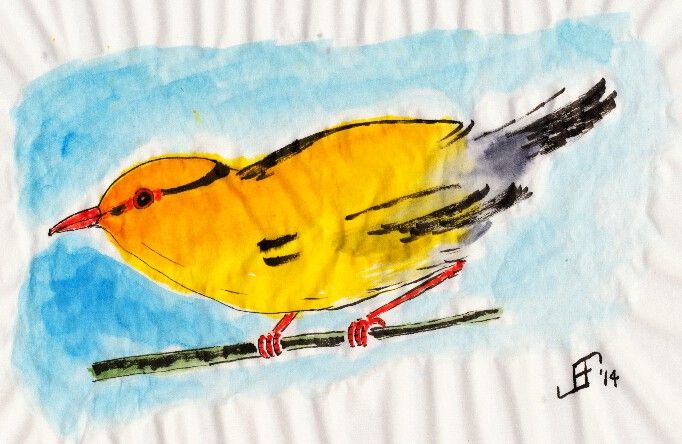
On this wonderfully sunny day (as I painted this), it seemed appropriate to use the chinese brush painting to paint an Oriole! Hopefully it will help brighten your day.
This brush painting is done with three different inks. Of course, I used Noodler's Black. the red and yellow are also Noodler's Ink.
The only downside of the yellow is that it will need to be mounted behind a sheet of UV protecting glass or acrylic. It tends to fade with exposure to UV light. Still both the yellow and red are very rich in tone and saturation.
You might wonder how I go about doing these paintings. I'm using Jane Dwight's The Chinese Brush Painting Bible. It is chock full of examples of various animals, fish, birds, plants, and flowers. I use it as a reference to learn how to do the painting. I then add the twist of using Noodler's inks instead of chinese watercolors. And I use my M. Graham watercolors, not the chinese watercolors. The difference is that the chinese watercolors tend to be made with a shellac type agent to help keep the watercolor pigment in place when it is wetted during the mounting process. I find a gentle touch with the brushes during the mounting process minimizes the amount of bleeding of the watercolors.
So, here's hoping you enjoy today's effort.
Saturday, January 11, 2014
20140110 - Robin
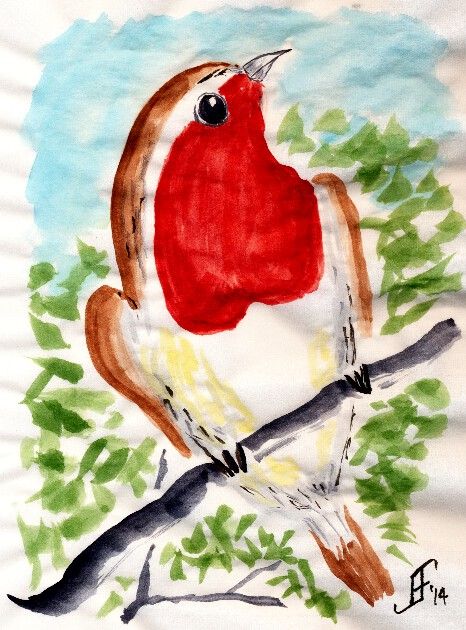 Here we are in the midst of January as I write this. It's a cold, bleak time of the year. It's a perfect time for a harbinger of brighter days. Isn't it about time to see the harbinger of hope, the robin? Well, probably not. But we can certainly remember their cheerful appearances and allow that memory to brighten our day.
Sigh! Sorry it took so long to post this picture. It appears Blogger is having problems with Google Chrome. But it worked in Microsoft Internet Explorer. Go figure.
I will probably mount this onto a pale golden colored backing paper. Here's hoping you enjoy today's project.
Wednesday, January 8, 2014
20140108 - Mounted Painting
I've been busy for a few days, but continue to try to practice my brush painting daily. I would like to specifically give a "shout out" to Henry Li of Blue Heron Arts. He specifically provides wonderful YouTube videos to help a novice learn more about Chinese Brush Painting.
For example, the following video shows how to mount a chinese brush painting onto backing paper.
 Using the technique shown in this video, I mounted the Sun 'n Bamboo painting. I mounted it onto a green mulberry backing paper that has gold flecks in it. As you can see the the smaller detailed pictyure, the green mulberry paper is quite striking.
 As you can see for a first attempt, I am pretty pleased with the results. As you might remember, the original painting that I posted was pretty heavily wrinkled and distorted. This is now much smoother.
Here you can see the painting mounted on the mulberry paper. The scanner can not scan the entire image, as the backing paper shows all around the four edges of the painting. I will then mount the backing paper into a traditional frame with a mat. The mat board will keep the painting away from the glass. And the mounting paper will and painting will be sandwiched between the mat and the mounting board.
With no interest at all, other than as a happy customer, I can recommend Blue Heron Arts. If you are interested in Chinese Brush Painting (or Sumi-E), then take a look at Henry's YouTube channel and store.
For example, the following video shows how to mount a chinese brush painting onto backing paper.
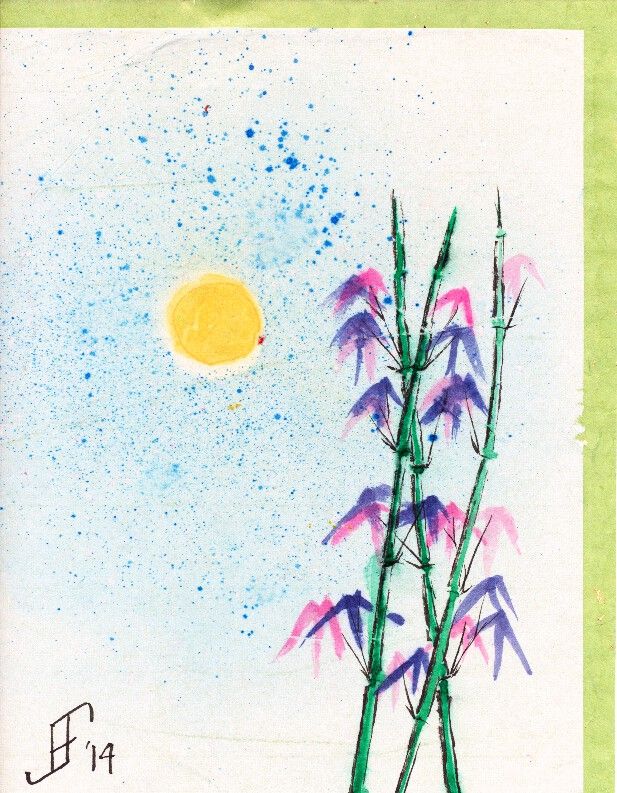 Using the technique shown in this video, I mounted the Sun 'n Bamboo painting. I mounted it onto a green mulberry backing paper that has gold flecks in it. As you can see the the smaller detailed pictyure, the green mulberry paper is quite striking.
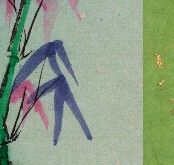 As you can see for a first attempt, I am pretty pleased with the results. As you might remember, the original painting that I posted was pretty heavily wrinkled and distorted. This is now much smoother.
Here you can see the painting mounted on the mulberry paper. The scanner can not scan the entire image, as the backing paper shows all around the four edges of the painting. I will then mount the backing paper into a traditional frame with a mat. The mat board will keep the painting away from the glass. And the mounting paper will and painting will be sandwiched between the mat and the mounting board.
With no interest at all, other than as a happy customer, I can recommend Blue Heron Arts. If you are interested in Chinese Brush Painting (or Sumi-E), then take a look at Henry's YouTube channel and store.
Saturday, January 4, 2014
20140104 - Sun and Bamboo
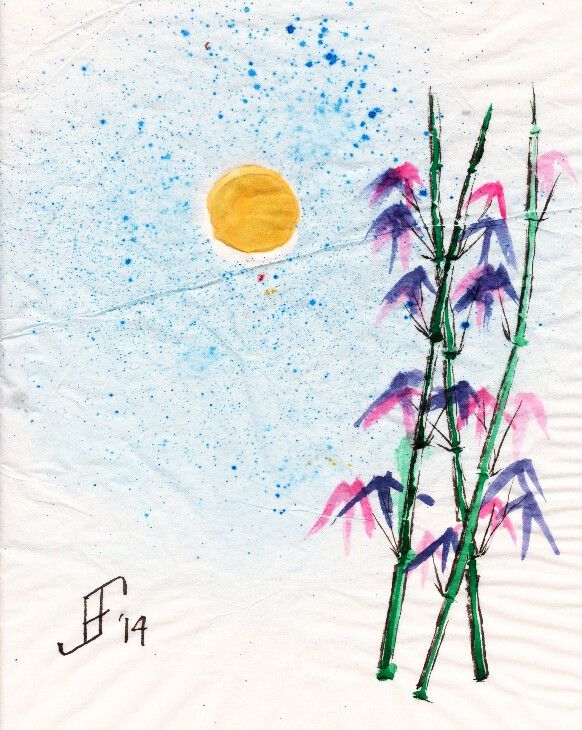 I continue trying to learn more how to do Chinese Brush Painting. Frankly, learning a new technique is a lot of fun. And in a way, by emulating the techniques of Chinese Brush Painting, I am learning how to be looser with my painting. The looser style (Freestyle or Xieyi or 寫意畫) is rather impressionistic.
Xieyi is also known as freehand style. Unlike gongbi (a realistic style), Xieyi does not seek to strictly reflect reality. Ancient artists believed that a painting should reflect how an artist sees an object, in addition to its actual appearance. The word "xieyi" means to "write to idea," and this style emphasizes the artists perceptions and thoughts as much as the actual form of what is being reflected. Proportion, light and perspective are all secondary to the artist’s personal conception of what an object is. (See http://bit.ly/1czohQ4 for the full text).
Learning how to suggest the branches, without all the detail is good practice for me. I hope you enjoy this effort as much as I enjoy learning the techniques. It should be interesting to see how well this does once I am able to mount it.
Friday, January 3, 2014
20140103 - Plum
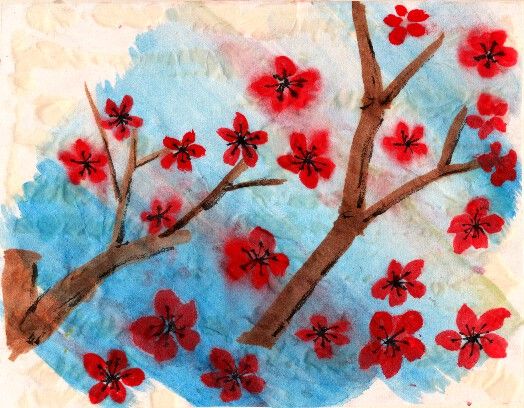 For my second painting (that I'm showing) for the day, I tried to do some Chinese Brush Painting. This technique uses different brushes and brush techniques than classic watercolor paper. Unfortunately, I don't have the correct mounting paste, so this one is mounted with Elmer's glue. As you can see, the results are less than ideal. Ah well! I'll put together a list of supplies I need.
I'm very happy with the feel of this painting. When properly mounted, it should provide some good results.
Here's hoping you will find this a cheerful painting, full of the promise of spring and warmer weather ahead!
Subscribe to:
Posts (Atom)